

FAMILY ORIGINS
Dr Machado, not Dr Carrillo
This is a good opportunity to explain to English speaking people that names in Spanish are constructed differently than in English, and as such you can keep track of who is son of who: Christian name (Antonio) + Father`s family name (Machado) + Mother´s family name (Carrillo) = Antonio Machado Carrillo.
In Portuguese, the order of family names is reversed: My name would be Antonio Carrillo Machado.
MACHADO (original)
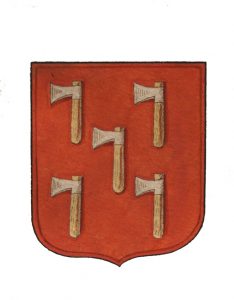
MACHADO
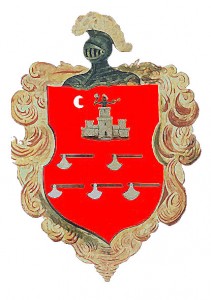
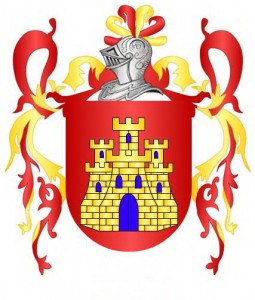
CARRILLO
Martín Pires Machado was the first person to use the surname Machado (12th century), apparently in honour of his grandfather Mem Moniz de Gandareis, who, along with his sons Nuno and Pedro, fought alongside King Afonso Henriques in the conquest of Santarém Castle (March 15, 1147), breaking down the gate with a machado (= battle axe), according to tradition. Mem Moniz de Gandareis belonged to the Portuguese nobility and was descended from Mem Moniz de Ribadouro, who was one of King Afonso Henriques’s closest collaborators (he held various positions at his court) and established the title of Gandareis, as well as another, the Bargosa, for his sister. It was during this period that the Kingdom of Portugal was consolidated.
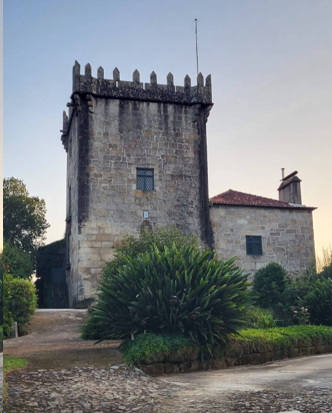
Martín Pires Machado, son of Pedro, was governor of the fortress of Lanhoso, in Guimarães. The Torre dos Machados manor house (now known as Torre do Castro) dates from about 150 years later and is located in the parish of Carrazedo in the municipality of Amare, with lands (15 hectares of vineyards) between the Cávado and Homem rivers, in the Geraz Valley. This house, with a moat, wall, and crenelated tower featuring gargoyles (e.g., one depicting a crocodile and another a man defecating), still stands today. It was renovated in 1699 and has recently been adapted and expanded for rural tourism. It has not belonged to the Machado family for a long time.
Alongside this information, other stories and legends have emerged that seek to portray the first Machado as an illegitimate son of King Afonso Henriques himself, thereby establishing a link to the royal lineage.
The Machado coat of arms appears for the first time in the nobility register painted by João do Cró (folio 128V) from the year 1509 and consists of five silver axes with gold handles on a red background. Later, in the 20th century, a coat of arms appeared that incorporated a castle (with one or more towers), five axes below, and at the top a warrior carrying a key and an axe, thus linking it to the battle and conquest of Santarém, which took place at night, which is why the coat of arms also incorporates a crescent moon, whereas the original coat of arms referred only to the meaning of the surname: machado = axe.
The Machados do not appear on the list of the 72 leading houses of the Portuguese nobility (Braganza, Avis, Sousa, Meneses, Noronha, Távoras, etc.) and are considered nobles of a lower rank. Nevertheless, the family has had a prolific lineage, with three main branches
- The Portuguese branch, which remains and extends across the Iberian Peninsula
- A presumed Sephardic branch (16th–17th centuries), according to non-historical sources, settled in Amsterdam and spread throughout North Africa and the Ottoman Empire. This branch uses the original coat of arms topped with two crossed axes
- The Canarian branch linked to Lope Machado, conqueror of Tacoronte in Tenerife (1497), which extends from the Canary Islands to South America (Brazil, Venezuela, Uruguay, Cuba, Argentina, Mexico, and Puerto Rico). In 1497, Lope received lands from the Adelantado Alonso Fernández de Lugo. As with any old Canarian family, the Machado family has mixed with other lineages settling in the Islands; Spínola y Lugo from Portugal, Comingues from France, Vernetta from Italy, etc. We are a pure mixed blood.
I represent the 23rd generation since the first Machado, and the 16th of the Canarian branch. Perhaps I am the first scientist in the family. Cool, isn’t it?
The Carrillo family started in times of the Count of Castilla Fernán González (X Century). It is said that two brother knights arrived from Germany and were so attached to each other, that they were called “the Carrillos” (carrillo = cheeks).
The Carrillo family split in several main branches and apparently more than one arrived to the Canaries during or shortly after the Conquest, settling in La Gomera, Tenerife and La Palma.
The line of my family came via Madeira and established in Los Sauces, in the NE of the Island of La Palma, about 1650. There, it mixed with various other lineages like the Flemish Wangüemert, Massieu from France, Cavanagh (today Kábana) from Ireland, Vargas or Valcárcel from mainland Spain, or Carballo from Cuba.
I represent the 13th generation since 1650.
TORRE DOS MACHADOS (Portugal)
A LARGE FAMILY IS A NET VALUE IN YOUR LIFE
